
In short
- Clean up the links you already have before you look for new ones.
- Where a link comes from matters more than how many links you have.
- A link intersection shows the sites that link to your competitors and not to you.
- Bought links and link networks are a risk, and we do not use them.
Our view
Much of the link building market sells a number: so many links a month. That number says nothing about where the links come from or what they point to. We would rather earn five links a quarter to the right pages than fifty to pages that cannot rank.
What is link building?
A link from another website to yours is called a backlink. Link building is the work of earning more of them, from sites that are relevant and trusted.
It is the main part of off-page SEO, the work that happens outside your own site. Two pages with similar content are often separated in the rankings by the sites that link to them.
What makes a link good
Links are not equal, and a few things decide how much one is worth.
- Relevance. A link from a site in your industry counts for more than one from an unrelated site.
- Trust. Links from sites that are themselves well linked carry more weight.
- Placement. A link inside the text of an article is worth more than one in a footer or a sidebar.
- Link text. Also called anchor text. The words of the link tell search engines what the target page is about. A natural profile has varied link text.
- Target. A link helps most when it points to the page you want to rank.
Links can also carry an attribute. A nofollow or "sponsored" link tells search engines not to pass authority in the usual way. A healthy profile has a mix, and the links without those attributes do most of the work for rankings.
Google introduced the sponsored and ugc attributes in September 2019, and it treats all of these marks as hints.
Step 1: audit the links you have
Start with your own profile. Pull the list of linking domains from a tool such as Ahrefs and from Google Search Console, then sort them by quality.
Some links can hurt. A toxic backlink comes from a spam site or a hacked site, or from an old campaign where links were bought in bulk. Google ignores most of them, yet a large number can lead to a manual action against the site.
- Where a site owner can remove a harmful link, ask.
- List the rest in a disavow file and submit it in Google Search Console. The file tells Google not to count those links.
- Find links that point to pages that no longer exist. Redirect those pages, so the links count again.
Step 2: find where competitors get their links
A link intersection compares your linking domains with those of your competitors. It lists the sites that link to several of them and not to you.
Those sites are the best place to start, because they have already shown that they link to companies like yours and they cover your topic. The list sets the priorities for outreach.
From our work
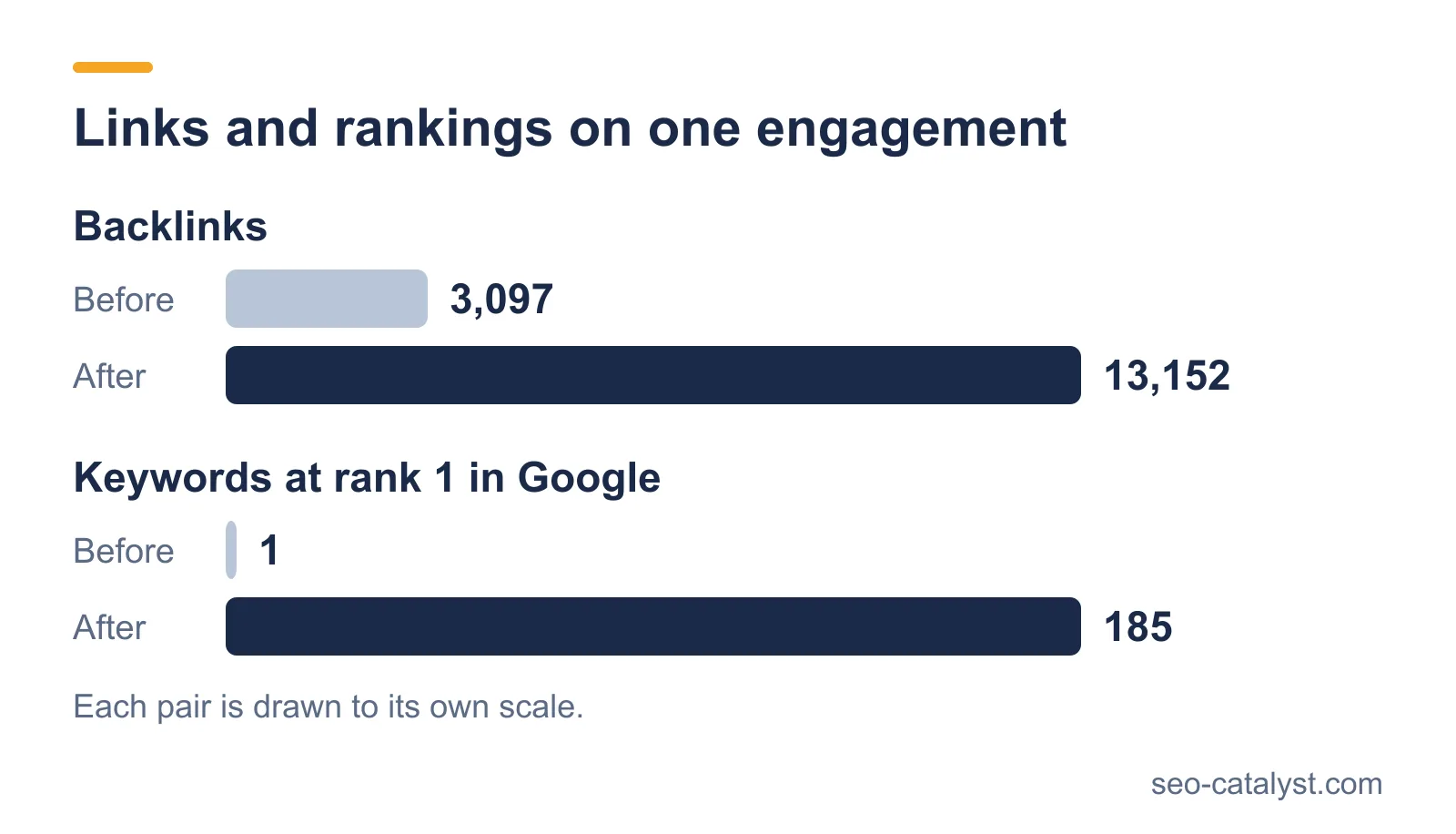
For an enterprise cybersecurity company, content built to earn links did most of the work. Backlinks grew from 3,097 to 13,152, and keywords at rank 1 went from 1 to 185. See the cybersecurity case study.
Step 3: give other sites a reason to link
People link to pages that help them make a point. Before any outreach, you need something worth citing.
- Original data. Numbers from your own product or research that nobody else has.
- Guides. A clear explanation of a subject that others can point their readers to.
- Definitions. A glossary entry that explains a term better than the alternatives.
- Tools and templates. A calculator or a checklist that people use and share.
From our work
On one site, keywords at rank 1 in Google grew from 61 to 352 against competitors with ten times more backlinks. Links matter, and they are not the only lever. A page that answers the search better can outrank a stronger domain.
Methods that work
| Method | How it works | When it fits |
|---|---|---|
| Outreach for linkable content | You show a relevant page to editors who write about the topic | You have a guide or data worth citing |
| Link intersection | You contact the sites that link to competitors and not to you | Competitors have clearly stronger profiles |
| Unlinked mentions | You ask sites that name your brand to add a link | The brand is already mentioned in the press |
| Broken link replacement | You offer your page in place of a dead link on another site | Your content covers what the dead page covered |
| Digital PR | You offer a story or data to journalists | You have news or original research |
| Partner and customer pages | Partners list you on their sites | You have integrations or resellers |
Outreach works when the message is specific. Say which page of theirs you read and which page of yours fits it, then say why their readers would care. A template sent to five hundred addresses is ignored.
Methods to avoid
- Buying links. Paying for links that pass authority is against Google's guidelines. It can lead to a penalty, and the links disappear when you stop paying.
- Link networks. Groups of sites built only to link to each other are easy for search engines to detect.
- Link exchanges at scale. A natural exchange between two partners is fine, but a program of "you link to me, I link to you" is not.
- Mass directory submissions. Low-quality directories add nothing and can look like spam.
- The same link text everywhere. Hundreds of links with the exact keyword as link text look manufactured.
We do not buy links and we do not use link networks. The risk falls on the site, and it is the client who carries it.
Google's spam policies list buying or selling links for ranking purposes as link spam. A paid link is allowed only when it carries a nofollow or sponsored attribute.
When to start link building
Link building comes after on-page work. A link sent to a weak page is wasted, because the page cannot hold the position the link helps it reach.
The order we follow is fixed: technical fixes first, then on-page optimization, then links to the pages that have started to rank. The clean-up of the existing profile can start earlier, because it protects the site.
How to measure link building
- New linking domains each month, and the ones you lost.
- The quality and relevance of the new domains.
- Rankings of the pages the links point to.
- Organic traffic and leads from those pages.
Count linking domains, since ten links from one site are worth far less than ten links from ten sites. Always report links next to rankings as well, because a link that moves nothing is a cost.
Brand mentions and AI search
AI assistants build answers from sources they consider reliable. A mention of your brand on a respected site can shape those answers even without a link. The question shifts from how many links you have to where your company is named.
Find the pages the assistants cite for your category, such as comparison articles and industry guides. Being included there is worth more than a link from a site nobody reads.
Frequently asked questions
What is link building?
Link building is the work of earning links from other websites to yours. Search engines read a link as a vote of trust, and pages with links from relevant sites tend to rank higher.
Is link building still important?
Yes. Links remain one of the signals search engines use to decide which page to rank, and mentions on trusted sites also influence what AI assistants say about a company.
What is a link intersection?
It is a comparison of the sites that link to your competitors with the sites that link to you. It lists the domains that link to them and not to you, which are the first places to earn new links.
Is buying links safe?
No. Buying links that pass authority is against Google's guidelines and can lead to a penalty. We do not buy links.
What is a disavow file?
A disavow file is a list of links or domains that you ask Google not to count. It is submitted in Google Search Console and is used for harmful links that cannot be removed.
How long does link building take to work?
A clean-up can help within weeks of the disavow being processed. Earned links build over months, and their effect grows as more relevant sites link to the same pages.
Related services and pages