
In short
- Set the goal in leads and pipeline, since rankings are only a means to it.
- Map keywords to pages by buying stage before you write anything.
- Fix the technical base first, then optimize pages, then build links.
- Review the plan every quarter against the baseline you recorded at the start.
Our view
A lot of B2B SEO starts with a blog calendar, because articles are easy to plan and easy to count. The pages that bring demo requests are left as they were. We start from the other end, with the pages closest to revenue.
What is an SEO strategy?
An SEO strategy states what you want search to bring the business and how you will get there. It names the searches you target and the page that answers each one. It also sets the order of the work and the indicators you will watch.
A list of tactics is not a strategy. "Publish two articles a week" is a tactic. "Rank the product pages for comparison searches, because that is where demo requests come from" is a strategy.
What makes B2B SEO strategy different
- Several people decide. The person who uses the product and the person who approves the budget search in different words.
- The buying cycle is long. A buyer may visit the site many times over weeks before filling in a form.
- Search volumes are small. A keyword with 200 searches a month can be worth more than one with 20,000, if the right buyer types it.
- The goal is a lead. A consumer site can count sales, while a B2B site counts demo requests and what happens to them in the CRM.
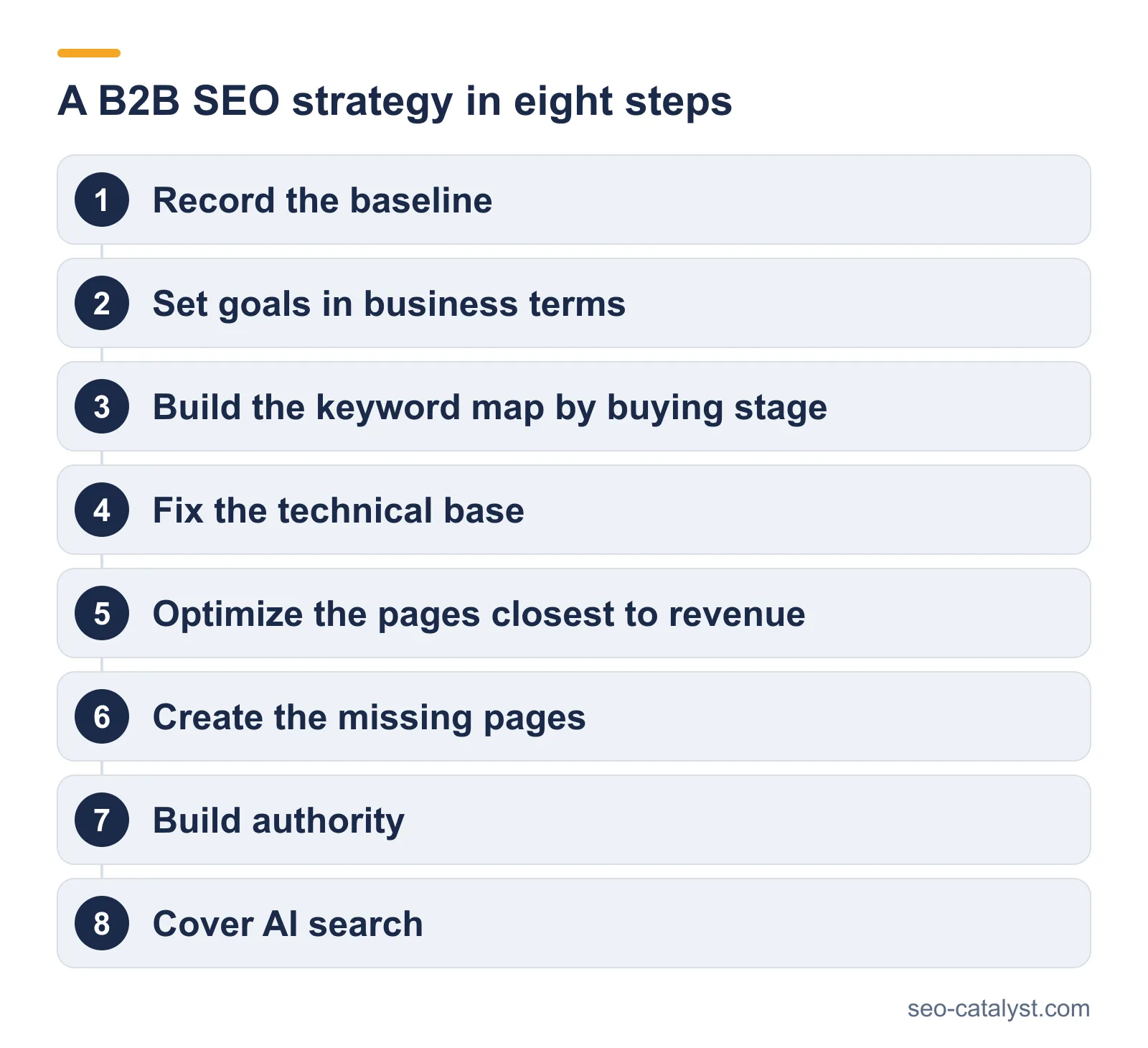
Step 1: record the baseline
Start with an audit that records the state of the site and its rankings, plus the leads that organic search brings today. Every later decision is measured against these numbers. See how to do an SEO audit.
Step 2: set goals in business terms
Agree with sales and leadership what search should deliver: demo requests or qualified leads. Then set the supporting indicators, such as rankings for a list of commercial keywords. If the goal is "more traffic", any traffic will do, and that is rarely what the business needs.
Step 3: build the keyword map by buying stage
Group keywords by where the buyer is in the decision.
| Stage | Typical search | Page that answers it |
|---|---|---|
| Problem | "how to reduce churn" | Guide or article |
| Category | "customer success software" | Category or product page |
| Comparison | "tool A vs tool B" | Comparison page |
| Decision | "tool A pricing" | Pricing or demo page |
Each group of keywords gets one page, and the map shows which pages exist and which are missing. The keyword research guide explains the method.
From our work
On one engagement the order was the same across three sites: a technical audit and keyword research against five competitors, then a new architecture, then on-page work page by page. See the EdTech case study.
Step 4: fix the technical base
Content cannot rank on a site that search engines cannot crawl or index properly. Fix those problems first, so every later page starts on solid ground. The technical SEO checklist lists what to check.
Step 5: optimize the pages closest to revenue
Work on the existing pages before you create new ones. Start with product and comparison pages, because buyers reach them when they are close to a decision. Measure each page before and after the work. The method is in the on-page SEO guide.
Step 6: create the missing pages
Now fill the gaps in the map, starting with the comparison pages and leaving the guides for earlier stages after them. Each new page should target one cluster and link to the pages around it.
Step 7: build authority
Links come after the pages are in order. Clean up harmful links first, then earn new ones with content worth citing and with outreach. See the link building guide.
From our work
For an enterprise cybersecurity company, this order was followed over the whole engagement: technical fixes, then content built to earn links, with paid search covering the gap while rankings grew. Keywords at rank 1 went from 1 to 185. See the cybersecurity case study.
Step 8: cover AI search
Buyers now ask AI assistants for shortlists, so check how the assistants describe your company and which sources they cite. Pages that state facts plainly and answer questions directly are easier for them to quote. See our AI SEO services.
SparkToro estimated that 58.5% of Google searches in the US ended without a click in 2024. Being named in the answer now counts alongside being visited.
Where paid search fits
SEO takes months, while paid search brings visitors from the first day. Running both on one keyword plan lets ads cover the terms where rankings will take longest. The ad data also shows which keywords convert, and that tells you which pages deserve SEO work first.
From our work
A medical laboratory set its targets before launch: 80 customers a day instead of 20, and around €1,000 in daily online sales. Three months later the new channel had brought 1,004 orders. See the MedTech case study.
What to measure, and when
| Phase | What to watch |
|---|---|
| Months 1 and 2 | Pages indexed, technical errors fixed, baseline recorded |
| Months 3 and 4 | Page scores before and after, keywords entering the top 10 |
| Months 5 and 6 | Organic sessions on commercial pages, leads from organic search |
| After month 6 | Qualified leads and pipeline attributed to organic search |
Review the plan every quarter. Keep what works, and move effort away from pages that do not respond. The guide on SEO KPIs and ROI covers measurement in detail.
Patience belongs in the plan. Ahrefs found that only 1.74% of newly published pages reach the top 10 within a year.
Common strategy mistakes
- Starting with the blog. Articles bring visitors who are far from a purchase, and they have nowhere to go if the product pages are weak.
- Chasing volume. High-volume keywords with the wrong intent bring visitors who never buy.
- Building links too early. A link to a weak page is wasted.
- No owner. A strategy that nobody is responsible for does not get implemented.
Frequently asked questions
What is a B2B SEO strategy?
It is a plan that names the searches a B2B company wants to win and the page that answers each one. It also sets the order of the work, and it is measured in leads and pipeline.
How is B2B SEO different from B2C SEO?
B2B purchases involve several people and a long decision. Search volumes are smaller and the content is more specific, and results are counted in qualified leads.
How long does an SEO strategy take to show results?
Technical fixes can change indexation within weeks. Rankings for competitive commercial terms usually take several months, and leads follow the rankings.
What should come first in an SEO strategy?
An audit and a keyword map, followed by the technical fixes and then the pages closest to revenue. New content and link building come after those.
Do we need a blog for B2B SEO?
Not at the start. Product and comparison pages bring buyers who are close to a decision, while guides help later, to reach buyers earlier in their research.
How often should an SEO strategy be reviewed?
Every quarter, against the baseline. Review it sooner after a product launch or a migration.
Related services and pages