
In short
- A keyword list is only useful once each keyword is tied to a page.
- Read the intent behind a search before you look at its volume.
- Group keywords into clusters by topic, and give each cluster one page.
- Each page gets one primary keyword and a few secondary ones.
Our view
The usual output of keyword research is a spreadsheet with thousands of rows that nobody opens again. A list is not a decision. Until every keyword is tied to a page, the research is not finished.
What is keyword research?
Keyword research has two outputs. The first is a list of the searches your buyers make, with how often each one is made and how hard it is to rank for. The second is a decision for each search: which page answers it.
It is the base of everything else in SEO. On-page work needs a keyword for each page, and content planning needs to know which pages are missing. Reporting, in turn, needs a list of keywords to track.
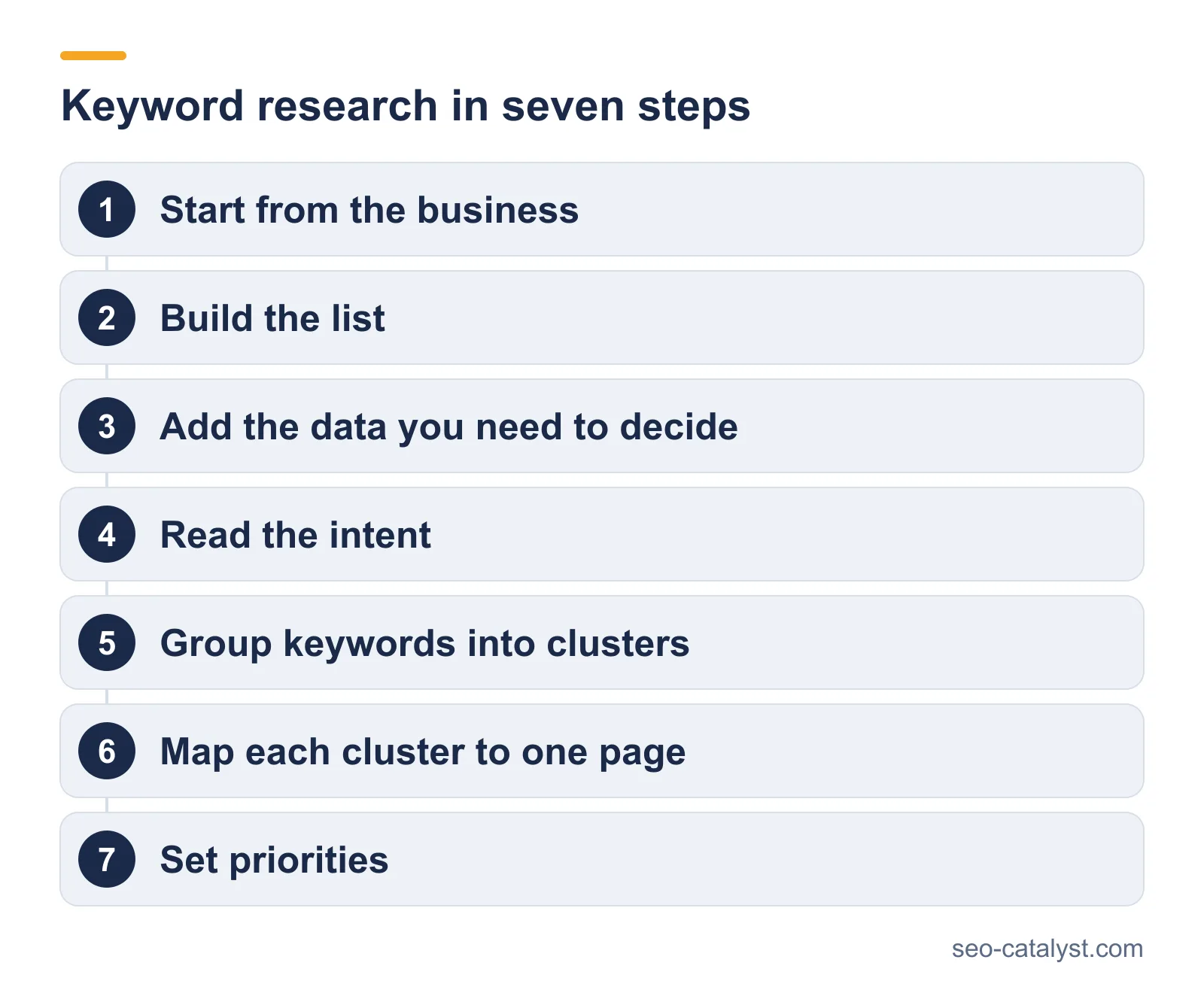
Step 1: start from the business
Begin with what you sell and who buys it. Write down your products and the problems they solve, then add the words your sales team hears on calls. These are your seed terms.
Buyers rarely use your internal vocabulary. A company may call its product a "revenue intelligence platform" while buyers search for "sales forecasting software", which is why seed terms should come from customers and from sales calls.
Step 2: build the list
Expand the seed terms from four sources.
- Google Search Console. It shows the searches your site already appears for, including ones you never targeted.
- Keyword tools. Tools such as Ahrefs and Semrush suggest related searches, with volume and difficulty.
- Competitors. The keywords your competitors rank for show what the market searches.
- The results page itself. "People also ask" and related searches show the questions around a topic.
Step 3: add the data you need to decide
For each keyword, record a few numbers. They are estimates, and they differ from tool to tool, so use them to compare keywords with each other.
| Column | What it tells you |
|---|---|
| Search volume | How many searches a month, in the country you sell in |
| Keyword difficulty | How strong the pages that already rank are |
| Intent | What the searcher wants to do |
| Current position | Where your site ranks today, if at all |
| Current URL | Which of your pages ranks for it |
| Cost per click | What advertisers pay, a sign of commercial value |
From our work
For one site we took on from zero, the research covered 4,741 keywords and five competitors. The value was in the map that came out of it: each cluster tied to a page, with the missing pages marked.
Step 4: read the intent
Search intent is the reason behind a search, and it decides which type of page can rank. There are four kinds.
- Informational. The searcher wants to learn: "what is crawl budget". A guide or a definition answers it.
- Commercial. The searcher compares options: "best SEO tools", "tool A vs tool B". A comparison page answers it.
- Transactional. The searcher is ready to act: "technical SEO agency", "SEO audit pricing". A service or product page answers it.
- Navigational. The searcher wants a specific site or brand.
Do not rely on the label a tool gives. Search for the keyword and look at the first page, because the type of page that ranks is the intent.
Do not dismiss small numbers. In the Ahrefs database for the US, almost 93% of keywords get fewer than 10 searches a month. In B2B, many of the searches that end in a deal sit in that group.
Step 5: group keywords into clusters
Many keywords are variations of one search. "On-page SEO" and "on page optimization" want the same page as "onsite SEO", so group them. A cluster is a set of keywords that one page can answer.
A simple test: if two keywords show mostly the same pages in the results, they belong in one cluster. If the results differ, they need separate pages.
Step 6: map each cluster to one page
Now give every cluster a page. This is the page map, and it is the real output of keyword research.
- If a page already ranks for the cluster, that page keeps it.
- If several pages rank for it, choose one and note the others as cannibalization to resolve.
- If no page exists, mark the cluster as a page you are missing.
Inside each cluster, pick a primary keyword. It is usually the one with clear commercial value and enough volume, phrased the way a buyer would say it. The other keywords in the cluster become secondary keywords for the same page.
| Cluster | Target page | Page status | Primary keyword | Secondary keywords |
|---|---|---|---|---|
| Technical SEO | /services/technical-seo/ | Exists | technical seo services | technical seo agency, technical seo audit |
| Site migration | /blog/site-migration-checklist/ | Missing | seo migration checklist | website migration seo, site migration plan |
| Tool comparison | /compare/tool-a-vs-tool-b/ | Missing | tool a vs tool b | tool a alternatives |
Step 7: set priorities
You cannot work on every cluster at once, so order them with three questions. How close is the search to a purchase? Can the site realistically rank for it? Does a page already exist?
Clusters where you already rank on the second page come first, because a small gain brings traffic quickly. New pages for commercial searches come next, and broad informational topics with strong competition come last.
From our work
An acquired site had been live for seven years and ranked for roughly 50 keywords. After keyword research against five competitors and a new site architecture, followed by page by page optimization, it ranked for over 1,600 keywords in the top 50. See the EdTech case study.
Be realistic about timing as well. Ahrefs found that only 1.74% of newly published pages reach the top 10 within a year, which is one more reason to start with pages that already rank.
Find the gaps against competitors
A keyword gap analysis lists the searches where a competitor is visible and your site is not. Run it against three to five competitors. The gaps are either pages you are missing or pages that exist and do not cover the topic well enough.
Treat competitor brand terms with care, because someone searching for a competitor by name usually wants that competitor. A comparison page can still earn part of that traffic, if buyers really compare the two.
To follow progress on a keyword list, we use a visibility score. It combines the position of each keyword with its monthly search volume, and it counts positions in the top 50. One number then shows whether the site is gaining ground on the whole list, and how it compares with each competitor.
Common keyword research mistakes
- Choosing by volume alone. A keyword with high volume and the wrong intent brings visitors who never buy.
- One keyword per page, taken literally. A page should target a cluster, with one primary keyword.
- Ignoring what already ranks. Search Console often shows pages close to the first page that nobody is working on.
- Stopping at the list. Without the page map, nobody knows what to do with the keywords.
- Doing it once. Searches change. Review the map at least once a year.
Keyword research and AI search
People ask AI assistants longer questions than they type into a search box. Add those questions to the research: the comparisons buyers ask for and the criteria they mention. They rarely show volume in a keyword tool, and they still decide who gets shortlisted.
Test the main buying questions in the assistants and note which brands appear. The answers show which sources the assistants trust, and they point to gaps in your own pages.
In practice we keep one relevant generic keyword for each page, so the page stays visible in classic search. The rest of the targeting moves to specific terms with clear intent, which is closer to how people phrase questions to an assistant.
Frequently asked questions
What is keyword research?
Keyword research is the process of finding the searches your buyers make and deciding which page on your site should answer each one. Its output is a keyword list and a page map.
What is a keyword cluster?
A keyword cluster is a group of keywords that one page can answer, because they mean the same thing or show the same results. Each cluster is mapped to a single page.
What is the difference between a primary and a secondary keyword?
The primary keyword is the main search a page targets. It goes in the title and the H1. Secondary keywords are close variations that the same page also answers, used in headings and in the text.
How many keywords should a page target?
One primary keyword and as many secondary keywords as belong to the same cluster, which is often between five and twenty. What matters is that they share one intent.
What is a keyword gap analysis?
It is a comparison of your rankings with those of your competitors. It lists the searches where they are visible and you are not, which shows the pages you are missing.
How often should keyword research be repeated?
Review the page map once a year, and whenever you launch a product or enter a new market.
Related services and pages