
In short
- Plan content from the keyword map, so every page has a search to answer.
- Organize pages in clusters: one parent page and the pages that support it.
- Update the pages you have before you write new ones.
- Write a brief for each page. A title alone is not a brief.
Our view
Most B2B content plans are built around what the company wants to say this quarter. Search does not care what you want to say. Content that ranks starts from what buyers already type, and the plan is built backward from there.
What is a content strategy for SEO?
A content strategy for SEO decides which pages a site needs and what each page covers. It also sets the order in which they are written. Its input is keyword research. Its output is an editorial plan in which every page has a target search and a place in the site structure.
Content marketing and SEO overlap here. Content marketing asks what will interest the audience, and SEO asks what the audience already searches for. A B2B plan needs both answers, and the second one is easier to measure.
Content types by buying stage
| Stage | What the buyer wants | Content type |
|---|---|---|
| Problem | To understand an issue | Guides and how-to articles |
| Category | To learn what solutions exist | Category pages and glossary entries |
| Comparison | To choose between options | Comparison pages and alternatives pages |
| Decision | To confirm the choice | Product pages and case studies, plus pricing |
Most B2B blogs sit entirely in the first row. The pages in the last two rows bring fewer visitors and far more leads, so they come first in the plan.
Most content never earns a visit. Ahrefs found that 96.55% of pages get no traffic from Google, which is the cost of publishing with no search behind the page.
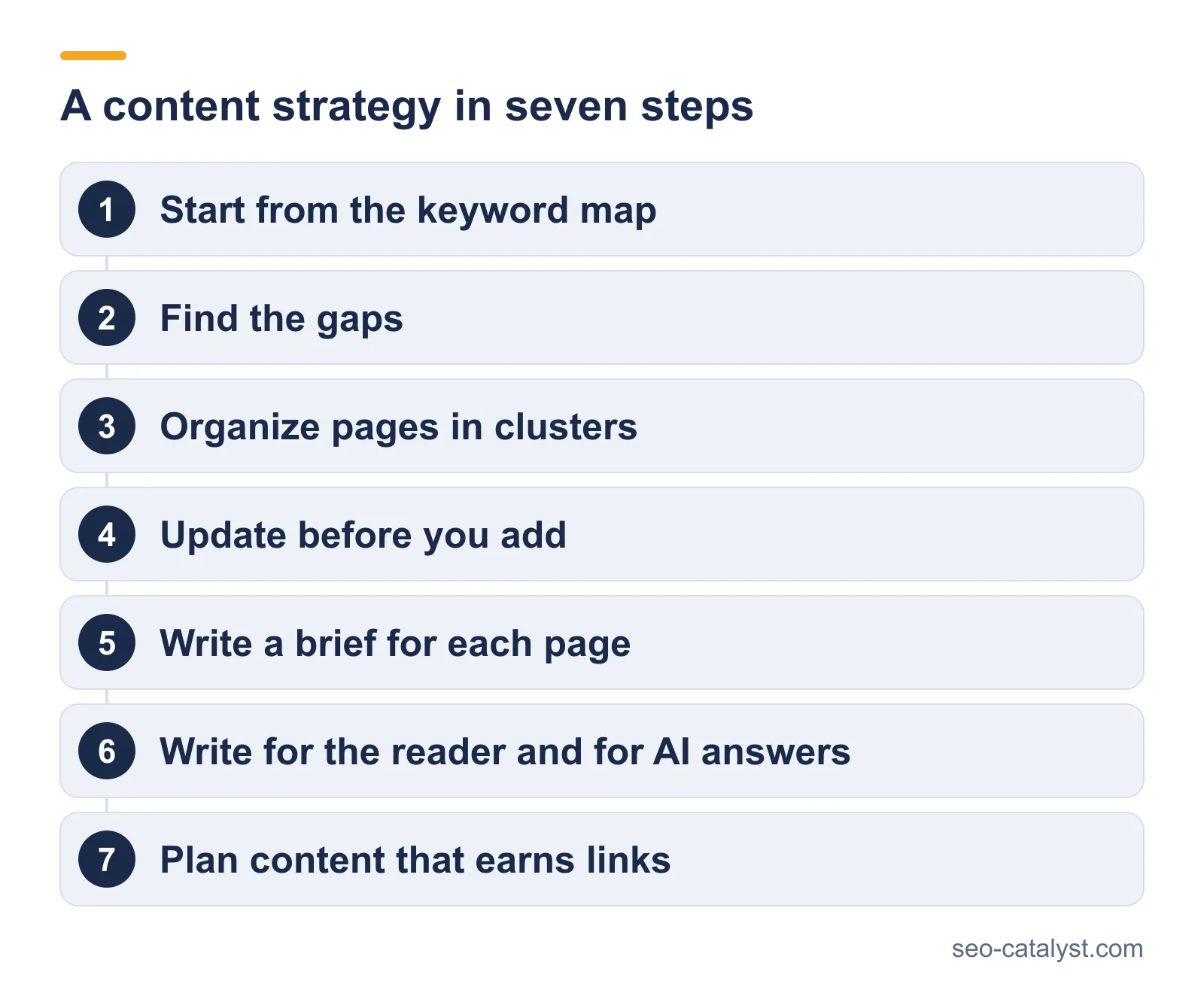
Step 1: start from the keyword map
The keyword map ties each group of searches to one page. It shows which existing pages rank and which do not, and it also shows the pages that are missing. The keyword research guide explains how to build it.
Step 2: find the gaps
A gap is a search where a competitor is visible and you are not. Run the comparison against your main competitors. Check each gap against the business before it enters the plan, because some keywords belong to products you do not sell.
Step 3: organize pages in clusters
A cluster has a parent page for the main topic and child pages for the related searches. The parent links to each child, and each child links back. Search engines read the group as one subject, which helps every page in it.
A cluster also prevents overlap. When two pages target the same search they compete with each other, and assigning each keyword to one page in one cluster removes that risk.
From our work
An acquired site had published for seven years and ranked for roughly 50 keywords. The content was there, and it was not organized around what people searched for. A new architecture and page by page optimization took it to over 1,600 keywords in the top 50.
Step 4: update before you add
A page that already ranks on the second results page is closer to traffic than a page that does not exist yet, so review existing pages first. Improve the ones with potential and merge the ones that overlap. The ones that serve no search can be removed.
From our work
A keyword map needs upkeep. When a client rewrote its pages on two topics, we created a cluster for each topic and added keyword groups to an existing cluster. We also refreshed the data in every other cluster. The next step was to optimize the main pages again against the updated map.
Step 5: write a brief for each page
A brief tells the writer what the page has to achieve. Without one, the writer guesses, and the result rarely matches the search.
- The primary keyword and the secondary keywords.
- The search intent, with the type of page that ranks for it today.
- The questions the page has to answer, taken from the ranking pages and from "People also ask".
- The terms the ranking pages use, from a TF-IDF analysis.
- The internal links to add, to the page and from it.
- The facts and examples only your company can provide.
Step 6: write for the reader and for AI answers
Put the direct answer near the top, in two or three plain sentences, then add the detail. A reader who is in a hurry gets what they came for. Search engines can lift the answer into a featured snippet, and AI assistants can quote it.
Use headings that repeat the question, and real lists and tables where the content is a list or a comparison. State facts plainly, with numbers.
SparkToro estimated that 58.5% of Google searches in the US ended without a click in 2024. An answer that can be quoted keeps your name in front of the buyer even then.
Step 7: plan content that earns links
Some pages are written to rank and others are written to be cited. Original data and clear explanations of a difficult subject attract links from other sites, and those links lift the whole domain.
From our work
For an enterprise cybersecurity company, the content plan mixed articles and guides with ebooks and infographics, each planned around what security teams search for. Backlinks grew from 3,097 to 13,152. See the cybersecurity case study.
From our work
For a new medical site, internal links on every page led toward the booking pages, and rich snippets showed prices and reviews in search results. Each page was written to move a visitor one step closer to an appointment. See the MedTech case study.
Who writes the content
In technical markets, the writer needs access to people who know the product. A common setup works well: an SEO specialist writes the brief and a subject expert provides the substance. An editor then makes it readable. Pages that compare your product with named competitors should also pass a legal review.
How to measure content
- Rankings for the primary keyword of each page.
- Organic sessions per page, against the month it was published or updated.
- Leads that started on the page, from the CRM.
- Links earned by the page.
Review each page a few months after it goes live. A page that has not moved needs a second look at intent, not more words.
Common content mistakes
- Publishing on a schedule with no keyword behind it. Volume of content is not a goal.
- Several articles on the same question. They compete with each other.
- Leaving old pages to decay. Outdated facts cost rankings and trust.
- Gating everything. A page behind a form cannot rank or be cited.
- No internal links. A new page that nothing links to is hard to find.
Frequently asked questions
What is a content strategy for SEO?
It is a plan that decides which pages a site needs and what each one covers. It also sets the order in which they are written. Every page in it targets a search that buyers make.
How is content marketing related to SEO?
Content marketing creates content the audience finds useful, and SEO makes sure that content matches what the audience searches for and can be found. A B2B plan uses both.
What is a content cluster?
A content cluster is a group of pages on one topic: a parent page for the main keyword and child pages for related searches, linked to each other.
Should we update old content or write new content?
Update first. A page that already ranks near the first page usually gains more from an update than a new page gains from being published.
How long should a B2B article be?
As long as it takes to answer the search fully. Compare with the pages that rank for the keyword and cover the subject at least as well.
How often should we publish?
There is no ideal frequency. One page a month that targets a real search does more than weekly posts with no keyword behind them.
Related services and pages