
In short
- Track KPIs at four levels: visibility, traffic, leads and revenue.
- Early indicators move in weeks, while revenue indicators move in months.
- SEO ROI needs the CRM, because a visit only has value once it becomes a deal.
- A report should say what was done and what changed, then what happens next.
Our view
SEO reports tend to show whatever went up. Traffic is the usual choice, because some traffic always goes up. A report that cannot follow a visit to a deal in the CRM describes activity, not results.
What is an SEO KPI?
An SEO KPI is a number you track to judge whether search work is moving toward its goal. The word "key" matters. A tool can produce hundreds of metrics, and only a few of them tell you whether the business is better off.
SEO KPIs by level
Each level answers a different question, and each one depends on the level before it.
| Level | KPI | Question it answers |
|---|---|---|
| Visibility | Indexed pages | Can search engines see the site? |
| Visibility | Keywords in the top 10 | Do the pages rank for the searches we chose? |
| Visibility | Share of visibility against competitors | Are we gaining or losing ground? |
| Traffic | Organic sessions on commercial pages | Do the right pages get visitors? |
| Traffic | Click-through rate from search results | Do searchers choose our result? |
| Leads | Leads from organic search | Do visitors ask to talk to us? |
| Leads | Sales-qualified leads from organic search | Does sales accept those leads? |
| Revenue | Customers and revenue from organic search | Does search pay for itself? |
Read click-through rate together with position. In a Backlinko analysis of about 4 million results, the first organic result had an average click-through rate of 27.6%.
Leading and lagging indicators
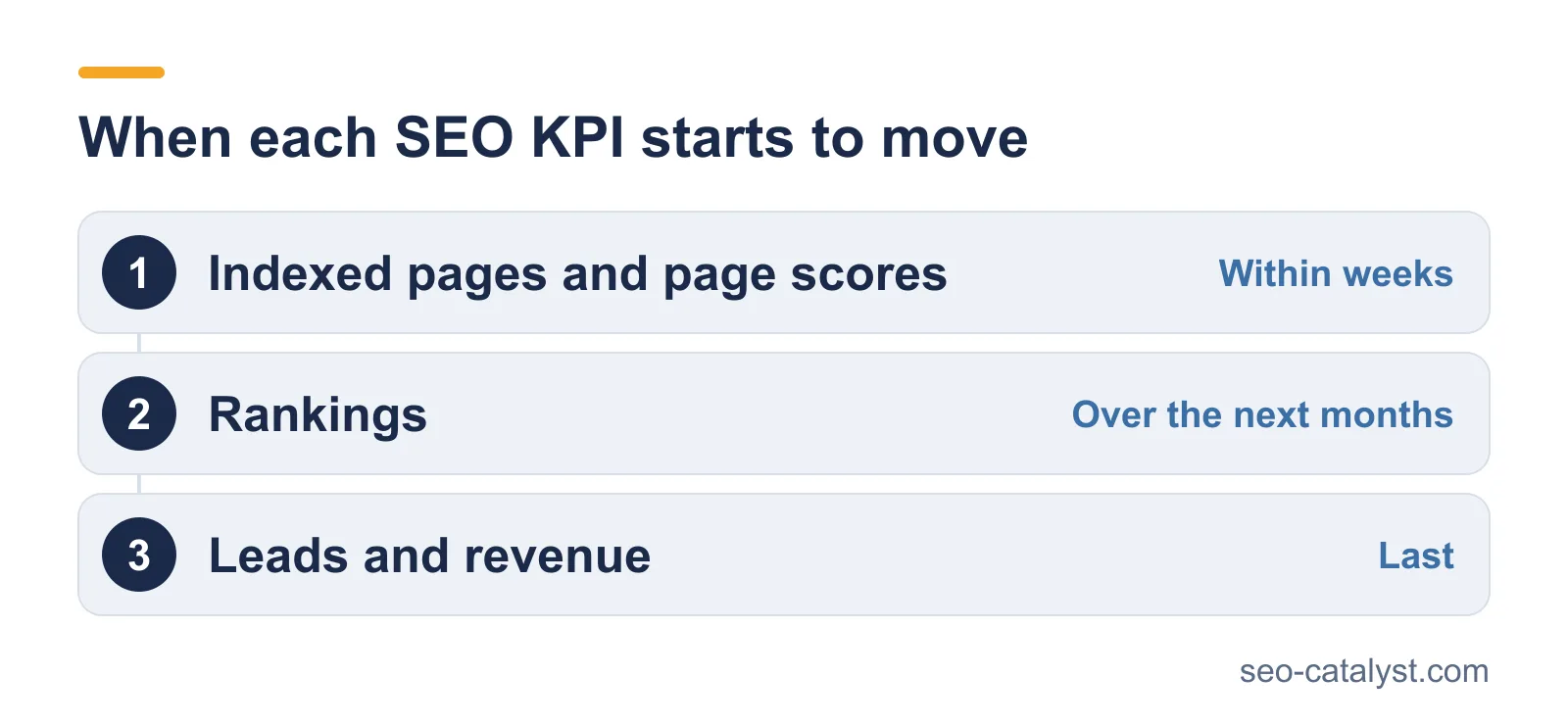
Some KPIs move early and some move late. Indexed pages and page scores change within weeks of the work, and rankings follow over the next months. Leads and revenue come last, because a B2B buyer takes time to decide.
Report both kinds. The early indicators show that the work is being done and is having an effect, while the late ones show that the effect is worth money. A report with only late indicators looks empty for months, and a report with only early ones never reaches the point.
Page-level KPIs
For on-page work, measure each page before and after. An audit tool gives a technical score and a content score, both calculated against the pages that rank for the same keyword. Record the position for the main keyword at the same two moments.
From our work
On one site we optimized 143 pages this way. Average on-page scores went from 42% to 88%, and keywords at rank 1 in Google grew from 61 to 352. The sheet per page made it clear which changes had worked.
From traffic to leads
Traffic becomes a KPI worth reporting only when you know where the visitor came from and what they did next. That needs two things. Forms have to record the source of the visit, and the CRM has to keep that source on the contact as it moves through the sales stages.
With that in place, you can compare channels on quality. In one CRM report, organic search turned visitors into contacts at 0.66%, against 0.28% for direct traffic. Organic search also brought 29% of the online customers of that company. Numbers like these tell leadership what the channel is worth.
From our work
In the same CRM report, paid search brought 41,449 sessions and 349 customers, at a contact to customer rate of 72.71%. Organic search converted contacts to customers at 62.28%. Seen side by side, the two channels could be judged on customers and not on clicks.
How to calculate SEO ROI
The formula is simple. Take the revenue that came from organic search in a period and subtract what SEO cost in the same period, then divide the result by the cost.
SEO ROI = (revenue from organic search - cost of SEO) / cost of SEO
The cost includes agency fees and internal time, plus tools. The revenue is harder. In B2B, use closed deals whose first or main source was organic search, taken from the CRM. If deals take months to close, also report the pipeline: open deals from organic search, with their value.
Two cautions. SEO spend in one quarter keeps producing revenue in later quarters, so judge ROI over at least a year. And a buyer often touches several channels before a deal, so agree on one attribution rule and keep it.
From our work
For a compliance firm, each department had its own sales target, so each campaign was tied to one objective. When goals changed in 2019, we paused the campaigns that did not convert at a good cost. Search conversions grew 27% that year. See the compliance case study.
What a monthly SEO report should contain
- The work done in the month, as a list of changes made on the site.
- The early indicators: pages indexed, page scores, keywords gained and lost.
- Organic sessions on the pages that matter, against the baseline.
- Leads and qualified leads from organic search.
- Position against competitors on the tracked keyword set.
- The plan for the next month, with the reason for each priority.
A report should fit a short meeting. If it takes an hour to explain, it holds too many numbers.
KPIs for AI search
AI assistants do not send a ranking report, so what you can measure is presence. Choose a fixed sample of buying questions and ask them in each assistant every month, recording how often your brand appears next to competitors. Visits from AI referrals in analytics are a second signal.
Treat this as an indicator. The answers change from day to day, and nobody can guarantee a citation.
Clicks are also under pressure from AI answers. Ahrefs found a 34.5% lower click-through rate for the top page when an AI Overview appears, which is why presence has to be measured next to traffic.
Common measurement mistakes
- Reporting total traffic. Visitors to a careers page are not prospects.
- Tracking hundreds of keywords with equal weight. A few commercial keywords matter more than the rest together.
- Counting branded searches as SEO results. People who search for your name already know you.
- No baseline. Without the starting numbers, growth cannot be shown.
- Changing the attribution rule. Numbers from two rules cannot be compared.
Frequently asked questions
What are the most important SEO KPIs?
For a B2B company: keywords in the top 10 for commercial searches, organic sessions on commercial pages, leads from organic search and qualified leads accepted by sales.
How do you calculate SEO ROI?
Subtract the cost of SEO from the revenue that came from organic search, then divide by the cost. Take the revenue from closed deals in the CRM, and judge the result over at least a year.
How long before SEO shows a return?
Early indicators move within weeks. Rankings take months, and revenue follows the rankings by the length of your sales cycle.
What should an SEO report include?
The work done, the early indicators, organic sessions on the pages that matter, leads from organic search and the plan for the next month.
How do you track leads from SEO?
Record the source of each visit on the form, and keep that source on the contact in the CRM. Reports can then show leads and customers by channel.
Can you measure visibility in AI assistants?
Partly. You can ask a fixed set of questions every month and record how often the brand appears, but it remains an indicator, since answers vary from day to day.
Related services and pages