
In short
- Lists of the best SEO agencies are a starting point. They tell you who exists, not who fits.
- Ask to see case studies with numbers, and ask who will do the work.
- An agency that reports only rankings and traffic cannot show you leads.
- A guarantee of rankings is a red flag, because nobody controls search engines.
Our view
Most agency proposals are impossible to compare, because they describe outcomes and hide the work. A proposal that does not state hours and deliverables asks you to buy on trust. We publish ours for that reason.
What an SEO agency does
An SEO agency helps a company get found in search engines. The work covers the technical health of the site and the content of its pages, plus the links that point to it. A good agency also measures what the work brings, in leads and sales.
Agencies differ in how much of this they do themselves. Some only advise and leave the changes to your team, while others also implement. Ask which kind you are talking to, because advice that nobody implements changes nothing.
Do you need an agency at all?
Before you compare agencies, check that an agency is what you need.
| Option | Works well when | Weak point |
|---|---|---|
| SEO agency | You need several skills at once and have no team | Quality depends on who is assigned to your account |
| SEO consultant | You have people to implement and need direction | One person, so capacity is limited |
| In-house team | SEO is a main channel and the work is constant | Slow to hire, and hard to cover every skill |
Many companies combine them. An in-house marketer owns the channel, and an agency brings the technical depth and the hands.
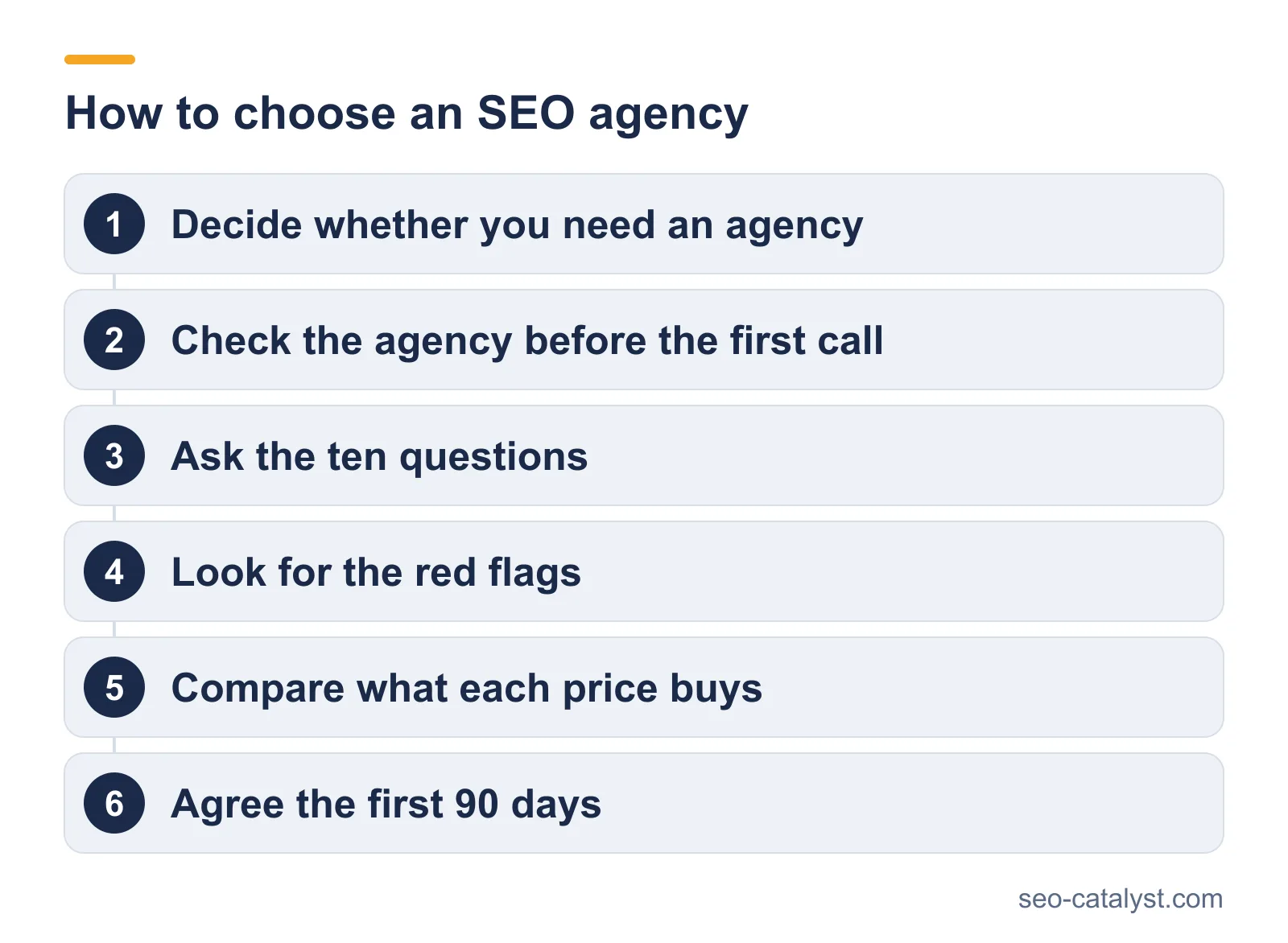
What to check before the first call
Case studies with numbers
Look for case studies that state the starting point and the result, with screenshots from real tools. "We increased traffic" is a claim. "Organic sessions went from 30,000 to 95,000 a month in 90 days" is something you can ask about.
Experience with companies like yours
B2B and consumer SEO are different jobs. A B2B purchase has several decision makers and a long sales cycle, so the keyword map and the reporting look different. Check that the agency has worked with your type of buyer.
How they treat their own site
An agency that sells technical SEO should have a fast, well-structured site. Check how it loads on your phone and whether its own pages answer the questions you came with.
From our work
One client started with us on a single website. During the engagement the scope grew to three properties, and the client later asked us to run an internal session on eCommerce SEO. A first project with a clear scope is a fair way to test an agency before a larger commitment.
Ten questions to ask an SEO agency
- Who will do the work on our account? You should meet the people, not only the person who sells.
- What do you do in the first month? A clear answer names an audit and the data they need from you.
- Do you implement the changes or only recommend them? Both are valid, but you need to know who does what.
- How do you choose which pages to work on first? Look for an answer based on business value and current rankings.
- How do you measure a page before and after the work? Without a baseline, nobody can show what changed.
- How do you build links? The answer should be content and outreach. Bought links put your site at risk.
- What will you report, and how often? Ask to see a sample report.
- Can you connect organic traffic to leads in our CRM? This is what separates SEO reporting from a traffic chart.
- What do you need from our team? Access and developer time are the usual blockers.
- What happens if we stop? You should keep the audit and the keyword map, with everything else that was produced.
Red flags
- A guarantee of first-page rankings. Nobody controls search engines, and Google itself warns against such promises.
- No names behind the work. If you cannot find out who will be on your account, expect juniors.
- Links sold in packages. A fixed number of links a month usually means a link network.
- Reports with rankings only. Rankings without leads tell you nothing about revenue.
- A long contract with no exit. Six months is a fair first term. Two years is not.
- A proposal with no audit. A plan written before anyone has looked at your site is a template.
From our work
A compliance firm began paid search with us as a proof of concept, with no account and no data. It worked in the first year, and the engagement ran for six more. When company priorities changed, we discussed the effect on results before we changed the account. See the compliance case study.
Google says the same in its guidance on hiring an SEO: nobody can guarantee a first-place ranking.
How SEO agencies charge
There are three common models. A monthly retainer covers ongoing work, and a fixed project covers one piece of work, such as an audit or a migration. Hourly billing is used for extra work outside the agreed scope.
Whatever the model, ask what the price buys in hours and in deliverables. Two retainers at the same price can hide very different amounts of work. Our own packages list the hours and the scope for each level, so you can use them as a reference when you read other offers.
For a sense of the market, Ahrefs polled 439 SEO providers. Agencies charged about $3,209 a month on average, and the most common retainer was between $501 and $1,000. Averages hide a wide range, so compare what each price buys.
How to compare two proposals
Put the proposals side by side and compare the same points in each.
| Point | What a good proposal states |
|---|---|
| Scope | Which pages and which markets are covered |
| Hours | How many hours a month, and on which activities |
| Deliverables | What you receive, by month |
| Method | The order of the work and why it is in that order |
| Measurement | The indicators and the baseline they start from |
| Team | Who works on the account and how senior they are |
| Terms | Length of the contract and notice period, plus who owns the work |
The cheapest proposal is rarely the one with the lowest price. It is the one where you can see what you get.
What the first 90 days should look like
A serious agency follows a similar path with every new client. The first month is an audit and a keyword map, and in the second month the technical fixes go live. In the third month on-page work starts and you get the first review against the baseline.
If three months pass and you have received only reports, something is wrong. Ask for the list of changes made on the site.
Ask about AI search
Buyers now ask AI assistants for shortlists, so ask the agency how it handles that. A good answer describes how they test what the assistants say about a brand and what they change as a result. Be careful with anyone who promises citations, because nobody controls the answers.
Frequently asked questions
How do I choose an SEO agency?
Check their case studies for numbers and ask who will do the work. Then ask how results are reported, and compare proposals on hours and deliverables, not only on price.
What questions should I ask an SEO agency?
Ask who works on the account and what happens in the first month. Ask how they build links. Ask how they measure a page before and after the work, and whether they can connect organic traffic to leads.
Are lists of the best SEO agencies reliable?
They are useful for finding names. Many lists are paid placements or written by an agency that ranks itself first, so use them as a starting point and check each agency yourself.
How long should an SEO contract be?
Six months is a reasonable first term, because results take that long to show. Be careful with longer contracts that have no exit clause.
Can an SEO agency guarantee rankings?
No. Search engines decide rankings and no agency controls them, so the most an agency can commit to is the work and honest reporting.
Should I hire an agency or build an in-house team?
An agency gives you several skills at once and starts faster, while an in-house team makes sense when SEO is a main channel and the workload is constant. Many companies use both.
Related services and pages