
In short
- Leads come from commercial searches, while informational searches mostly bring readers.
- A page converts when it matches the search and offers one clear next step.
- Record the source of every lead on the form and keep it in the CRM.
- Paid search covers the months before organic rankings arrive.
Our view
Lead generation is often treated as a volume game: more forms and more names in the CRM. Sales then ignores most of them. We count a lead when sales accepts it, and we judge search by that number.
How SEO generates B2B leads
The path has four steps. A buyer searches for a problem or a product, and when your page appears they click. The page answers the search and offers a next step, which they take by filling in a form or booking a call.
Each step can fail. The page may not rank, or it may rank for the wrong search. It may also rank and then say nothing useful, or be useful and still offer no way forward. Lead generation through SEO is the work of fixing each of those points.
Which searches bring leads
Not every visitor is a prospect. The words of the search tell you how close the person is to a decision.
| Search type | Example | Value for leads |
|---|---|---|
| Informational | "what is zero trust security" | Low now, useful for later recognition |
| Category | "endpoint security software" | Medium: the buyer is exploring options |
| Comparison | "vendor A vs vendor B" | High: the buyer is choosing |
| Service or pricing | "endpoint security pricing" | Highest: the buyer is ready to talk |
A lead generation plan starts from the bottom of this table. Those searches have less volume and far more intent.
Small volumes are normal here. In the Ahrefs database for the US, almost 93% of keywords get fewer than 10 searches a month.
Which pages turn visitors into leads
- Product and service pages. They answer "what do you offer" and should lead to a demo or a call.
- Comparison pages. They answer "why you and not them". A fair comparison is more convincing than praise.
- Pricing pages. Buyers look for them early. A page with real figures, or at least a clear range, filters out poor fits.
- Case studies. They answer "has this worked for a company like mine".
- Guides. They rarely convert on the first visit. Their job is to bring the buyer back later, by name.
From our work
A medical laboratory had taken about 20 appointments a day, all by phone or in person. Three months after its site launched, between 10 and 20 clients booked online every day, and over 60 visited the lab after finding it through search. See the MedTech case study.
What makes a page convert
A page converts when three things are true. It matches the search that brought the visitor and it gives proof, such as numbers and named results. It also offers one clear next step.
The next step should fit the stage. A visitor on a guide is not ready for a sales call, so offer something lighter, such as a checklist or an audit. A visitor on a pricing page is ready, so offer the call.
Keep forms short and ask only for what sales needs to start a conversation, because every extra field costs submissions.
Track the lead back to its search
Without tracking, SEO gets credit for traffic and nothing else. Three pieces make the link visible.
- The site records where each visit came from: the channel and the landing page, plus the campaign if there is one.
- The form sends that source with the contact details.
- The CRM keeps the source on the contact through every sales stage, to closed deal.
With this in place, a report can show qualified leads and customers by channel. It can also show which landing pages start the journeys that end in deals.
Lead quality, not lead count
A form fill is not yet a lead worth counting, because what matters is whether sales accepts it. A sales-qualified lead is a contact that sales has confirmed as a real opportunity.
Report at that level. If organic search brings many contacts and few qualified leads, the site is ranking for the wrong searches. Channels can then be compared on quality, as in one CRM report where organic search converted visitors into contacts at 0.66%, against 0.28% for direct traffic.
Where paid search fits
SEO takes months to produce leads, while paid search can produce them in the first week. Running both on one keyword plan gives you leads now and lowers the cost of leads later.
From our work
For an enterprise cybersecurity company, SEO and paid search ran on one plan. The paid campaigns brought 1,692 sales-qualified leads in one year, while organic rankings were being built. See the cybersecurity case study.
Ad data also improves the SEO plan. It shows within weeks which keywords produce qualified leads, and those keywords become the priority for organic work.
From our work
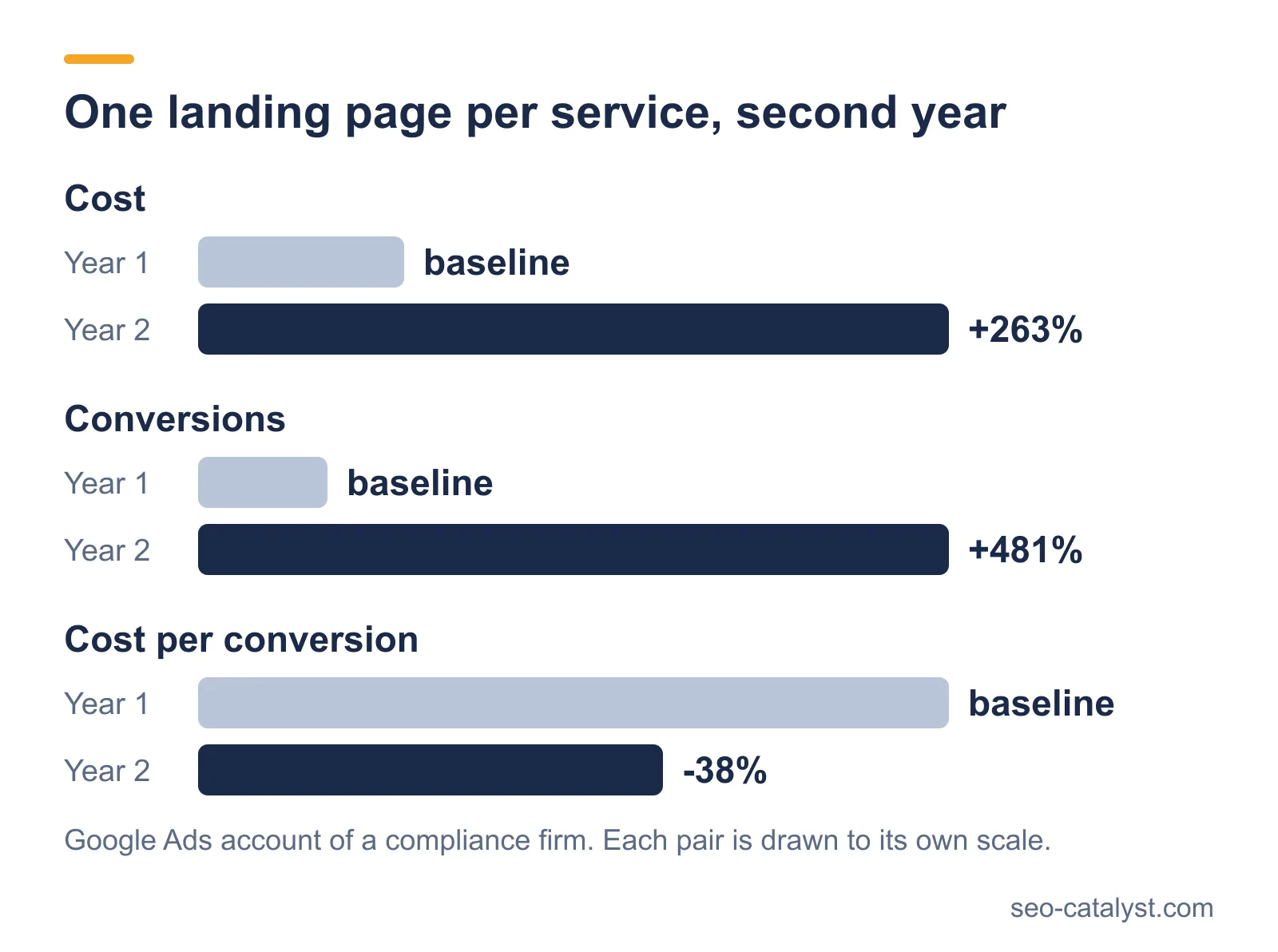
For a compliance firm, every service got its own campaign and its own landing page in the second year. Cost grew 263% and conversions grew 481%, so the cost per conversion fell 38%. A page built for one service converts better than a general page.
How long it takes
Expect three phases. In the first two months the site is audited and fixed, and nothing visible changes in leads. From the third month, pages start to rank and commercial traffic grows. Leads follow, delayed by the time your buyers take to decide.
Pages that already rank on the second results page shorten this. Start with them, because a small gain in position brings traffic quickly.
Ahrefs found that only 1.74% of newly published pages reach the top 10 within a year, so plan for the wait.
Common mistakes
- Targeting only informational searches. Traffic grows and leads do not.
- One form for every page. A "contact us" form on a guide asks for too much, too early.
- No source on the lead. Sales cannot tell which channel to thank.
- Counting form fills. A hundred unqualified contacts are worth less than five qualified ones.
- Stopping at the lead. If the CRM does not follow the contact to a deal, ROI cannot be calculated.
Leads from AI search
Some buyers now arrive from AI assistants, already holding a shortlist. Track those visits as their own source. In one CRM report, 1,098 sessions came from AI referrals and converted to contacts at 1.37%, about twice the rate of organic search.
The numbers are still small. They are worth tracking now, so that you have a baseline when the channel grows.
Frequently asked questions
How does SEO generate leads?
Buyers search for a problem or a product and find your page. Then they take the next step it offers, such as a demo request. SEO makes sure the right pages rank for those searches and are built to convert.
Is SEO good for B2B lead generation?
Yes, because B2B buyers research before they contact sales. It is slower to start than paid search, and the cost per lead falls over time as rankings hold.
How long does it take to get leads from SEO?
Usually several months. Technical fixes come first and rankings follow, then leads follow rankings by the length of your sales cycle.
Which pages generate the most B2B leads?
Product and pricing pages, plus comparison pages, because buyers reach them when they are close to a decision. Guides bring earlier-stage visitors.
How do you measure leads from SEO?
Record the source of each visit on the form and keep it on the contact in the CRM. Then report qualified leads and customers from organic search.
Should we use SEO or paid search for leads?
Both, on one keyword plan. Paid search brings leads from the first week and shows which keywords convert, while SEO builds a source of leads that does not depend on ad spend.
Related services and pages